Feeds:
Posts
Comments

Posts Tagged ‘sustainability’

Tom Ogren is a genius. Last week we did a frenetic cross-town exposition on plants, allergies, and health with him. As he showed us around SLO, pointing out the allergy-inducing plants that abound in public places, it sunk in to me that we’ve been pretty careless about how we’ve landscaped our homes and our city. (I’ve created an interactive map of our journey so you can follow along and see which plants Tom identified).

Tom explaing the finer points of oak pollination to me.

Enter Tom Ogren. His findings mark the next step in creating a sustainable, livable environment. In a nutshell what Tom has discovered over 25 years of investigation and analysis is that allergies are getting worse—and we are responsible.

Why? Because we apparently don’t like cleaning up a mess.

Now, during our walk, Tom threw out a few latinate terms that I certainly can’t remember (you’ll have to read his book to get the full story), but the gist is that many female plants produce seeds or berries.

Which fall off.

Which we then have to pick, sweep, or scoop up.

So, to avoid the trouble, we just plant male trees instead. And this is where we shoot ourselves in the foot—or up the nose. Because male trees usually produce pollen.

Tons of it.

And since it doesn’t have anywhere else to go, it goes right up the schnoz.

Bottlebrush: it might look gorgeous, but you'll want to enjoy from a distance

Not that any of this was intentional: for many years landscapers and homeowners simply chose plants based on their aesthetic appeal. The most obvious example of this type of philosophy can be seen in the water-intensive lawns and plants that still dominant our cityscape. Now, however, given the burgeoning awareness of our limited resources, there has been a concerted move toward sustainable landscapes. Beautiful new front yards are beginning to appear based on this new, sustainable approach.

We need the same awareness to burgeon (I love that word) about creating allergy-free landscapes. It is a means of creating a sustainable environment for our eyes, lungs, and immune system. Seriously. Given the amount of money we invest in anti-allergy medications, this is a very expensive problem that could significantly reduced simply by changing our landscaping practices.

And some cities are already doing it. With Tom’s advice and guidance, several cities in the southwest and, believe it or not, in New Zealand, have adopted landscaping policies that forbid certain plants and that require the planting of female versions of others. They’re very progressive. Even feminist.

Lastly, Tom recommended a few things you can do to at least limit the effect of seasonal allergies. A list:

  • DON’T rub your eyes. Some pollens look like miniature ninja stars or balls of spikes, so rubbing your eyes when they itch will only result in itchier eyes that are now bloodshot
  • If you’ve been outside for a while (especially if it’s been windy), take a shower and put on fresh clothes once you’re inside
  • If your allergies are really bothering you, stay in the shower, close all the windows and the door, and make it hot—the steam will help clear your sinuses
  • If it’s a bad allergy day and you can make it to the beach, do it—the fresh air from the ocean will clear you up
  • Lastly, and most importantly, buy and eat local honey

I had no idea the last bastion of male dominance would be in the plant world. Go figure. Now that I do know, feminists unite! Let’s get female plants their rightful place in our yards and streets!

How about you? Do you have allergies? Have they gotten worse? How do you deal with them?

Read Full Post »

I’m not very good at the whole “right on schedule” thing, I must admit. That said, here are a few shots of the “winter” garden just as we start to transition into a “summer” garden.

Here in SLO we should probably label the seasons “wet” and “dry,” but I’m splitting hairs.

I’m afraid we pulled some of the leeks a tad early. (Sorry, Heidi! It looks like we’ll have to use non-homegrown leeks for the lasagna). The white parts need to be, like, three times longer.

On a positive note, the broccoli is finally taking off. I can’t wait to dig in! (In fact, I kinda already sneaked some. Shhh…)

In a week or two I’m going to post a detailed review of our winter garden. In the meantime, here’s a quick winter garden wrap up, with the winners, the competitors, and the also-ran.

The winners:

  • bok choy (one word: prolific)
  • leaf lettuce (just keeps growing and growing and…)
  • spinach (just keeps growing and growing and…)
  • green onions (SO sweet and tangy)
  • radishes (our fastest growers of the season!)

The competitors

  • broccoli (slow starter, but we’re seeing action now!)
  • head lettuce (died back very quickly after reaching “peak”)
  • leeks (need lots of time to grow)

The also-ran

  • red and yellow bulb onions (la de da, any DAY now)
  • carrots (had better luck with the summer batch)

I must say, it was a great first experience with a winter (wet season) garden. I’m already planning for next year.

How about you? Did you do a winter garden? How did it go?

Read Full Post »

Thank you, Freecycle! We just picked up two real (as in designed for the purpose) worm bins. And we even got the red wrigglers. Now, along with our homemade bin, we will have plenty of compost and castings. Plenty.

Worms and all!

The woman who freecycled the bins told us that she had gotten them for free from the City of SLO. Time to put on the Deerstalker and investigate!

Hercules and Catwoman are thrilled!

Read Full Post »

First, for those of you with RSS readers, I fixed the blog title so it shows up on the feeds again. (Thanks for the heads-up, Chris!)

And now, the next episode! It’s a  jam-packed one. My mom and I are really starting to get the hang of this—except maybe for the whole indoor lighting thing. You’ll see what I mean.

Wait until you see the garden! It’s insane how big the veggies (and the sunflowers) got. I mean it. Insane. We also get to the SLO Farmers Market, where I interview some of our local farmers (and a bee keeper). Logan and Kaia track down some lizards to show us, and my mom and I have a coffee and talk about the triple bottom line philosophy. Like I said, jam packed!

I’m totally stoked at the momentum we’re building for Hole in the Fence. There are great things happening here and I can feel the energy! I hope you do, too.

Let us know what you think in the comments. We love your feedback!

Read Full Post »

I love the rain! So does the garden!

So do the weeds. It was time to do some serious weeding.

I pulled the big weeds right out of the rain-soft ground. I’ve found there’s actually an art to pulling weeds with the entire rootstalk intact. And I really get into the challenge of seeing how many weeds I can pull out whole.

The kids jumped right in. Logan gathered the weeds I’d pulled and Kaia played in the mud.

On the smaller weeds we used straight white vinegar, which is, as I’ve said before, the edible version of Round Up.

And by edible I mean, if you get a bit peckish while your weeding just grab some lettuce, apply a little of your weed killer, and voilà! instant salad.

It’s weird: a project can look massive and onerous, but once I get rolling it’s done in half the time AND I end up enjoying it. Or maybe that’s just me—made half crazy from all the vinegar.

P.S. I also wanted to demonstrate my awesome weed-pulling skillz with an animated gif, but the site that would have allowed me to do that suffered a server crash, so…another time!

Read Full Post »

Okay, so the environmental group I’m working with? The one I just blogged about? You might have guessed by now that it’s ECOSLO. Well, they’re taking part in Art After Dark, and last night they had Adam Hill, the new District 3 County Supervisor, as their guest. And I’m affirming that they are definitely doing good things. I met some very cool people there (in addition to Adam, of course).

However, the event was attended by about 45 people, max. I know, because I was there the whole night, lurking. (That’s me: I lurk). And the type of people who attended were the type you’d expect: the wonderful, the well-meaning, the converted.

Total mildly curious and/or drunk attendees? Zero.

Now, maybe I’m being totally unrealistic, but I would have liked to see three times that amount. I mean, it was a chance to meet with a supervisor (and for some of us, a former instructor)! Not only that, but he’s cool. Actually cool. A politician. I know.

I’m drifting. Back to my point. Which was…. If an organization wants to stay viable it has to practice a certain amount of openness and inclusiveness. This has always been a truism, but now, with the current green zeitgeist racing through our collective consciousness, the time is perfect for opening heretofore closed doors.

Have to you ever thought that maybe, just maybe, thinking certain things actually brings them into existence? (Some physicists do, but they’re crazy.) Or maybe because you’re thinking of something you are more aware of similar phenomena? Anyway, I had just written the last post about inclusivity when I came across this article, tweeted by one of our followers. In the wonderful article (that is now in my “special” folder on my laptop), the author, Andrew Outhwaite, lists common barriers to achieving effective, long-term change. This one REALLY nails my thesis on the head:

Barrier: Being too identified with your own profession/network/clique, and its language, symbols, models, paradigms and habits can seriously inhibit inter-network collaboration, even within the sustainability movement.

Community-Enabling Technology: Encouraging information Cross-Pollination. Universities (e.g. BTH, UTS and RMIT) are encouraging transdisciplinary research to enable innovation across departmental, sectoral and epistemological boundaries.

Time to broaden the horizons, methinks. And to prove that I’m not letting any grass grow under my observations, I’m off to meet with Chris McCann, a student a Cal Poly who’s part of the Empower Poly Coalition and the business community. Let the synergies begin!

Read Full Post »

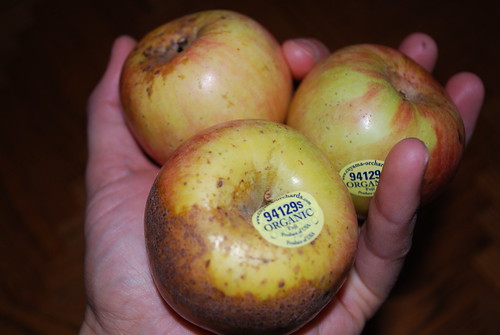
So, you know when you go to the store for milk, you can never get just milk? After the gym last night I ran in to New Frontiers for…milk. But the apples were calling to me. They were local, See Canyon apples, and they looked DELICIOUS; they also looked different. Different than the typical apples I see in most stores. Oddly, the small, mottled, blemished organic apples appealed to me more than the large, shiny, symmetrical apples. (Yes, I think about this kind of stuff all the time. It drives Denette crazy.)

And here’s where I started getting philosophical. (Denette is rolling her eyes right now).

Until recently the mindset has been shiny = new = good. There is some logic in this. After all, bruised = old = good doesn’t sound very reasonable. (Sounds pretty gross, actually). However, the little red orbs of waxed perfection represent something completely different to me: shiny = commercial = bad. shiny, conventional apples

The main issue here is not that perfection is bad, or even that striving for perfection is bad—those are both goods in my book—but that the appearance of perfection is bad. In the case of the commercial apples, the process of making pretty things is actually deceptive: it hides the imperfections that exist and creates a false impression of fresh loveliness. I’ve bitten into the shiny commercial surface before only to be surprised by the woody dryness of an apple well past its prime freshness date. Because the apple had to drive 2,500 miles to get here, it’s bound to be old and tired after a journey like that.

And do I even need to mention the hidden chemical badness? Probably not.

I’m seeing a trend away from the shiny/new/good perspective, and I hope it will continue. Because if more people develop a different mindset about what indicates good food then demand will go up. Then maybe producers and distributors wouldn’t need to spend so much time and money prettifying, packaging, and preserving our foodstuffs. Instead, they could focus on getting us the best tasting, healthiest local products.

Speaking of healthy and local. Check out this new Co-op in SLO. Good things are happening!

Read Full Post »

I had an astute friend ask me to track expenses on the projects we’re doing. With the economy at the forefront of everyone’s minds, I think that’s a great idea. We can demonstrate in very real terms how much it costs (or saves!) to do the sustainable thing.

I’ve placed the tracker on the TV Episodes page. It’s pretty rough right now, but I’ll refine it as time goes on. One of the things I can already think of is how to demonstrate savings as well. For instance, we haven’t used our electric dryer for three weeks. I’m sure that’s saved us some substantial pocket change.

Let me know if you can think of anything else we should be tracking—financially or otherwise.

Read Full Post »

First, I rent. Second, my landlord is awesome. Third, he’s also very much into order and neatness.

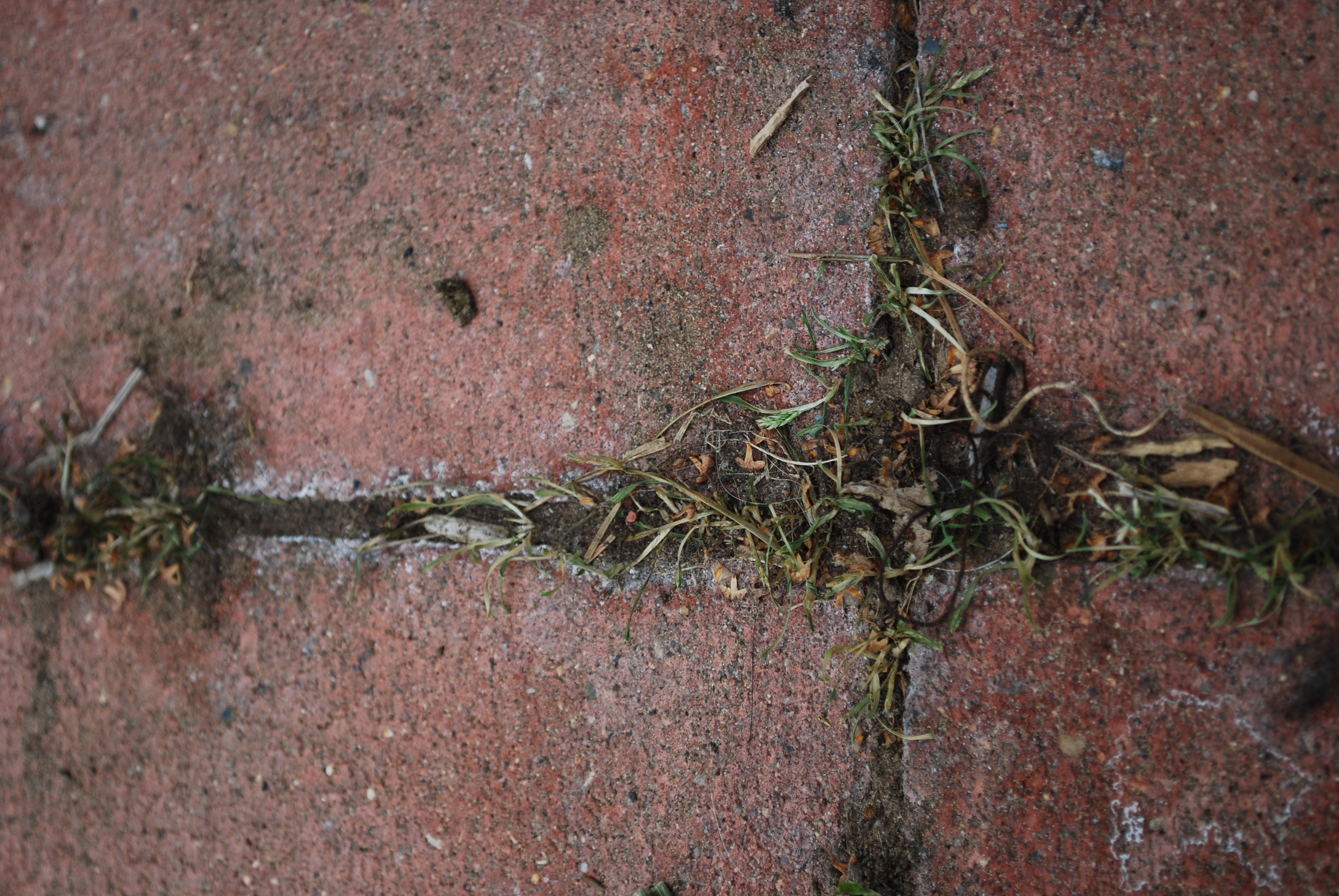
So, a few months ago he was was doing his usual landscaping check and he noticed some weeds growing up between the cracks of the stones on the back porch.

“I’ll take care of those next week,” he said.

What I heard: I’m going to soak your back porch with glyphosphate.

He’s an awesome guy, but not so much into the organic thing. Expediency and efficiency drive his decisions. So I talked him into letting me take care of it.

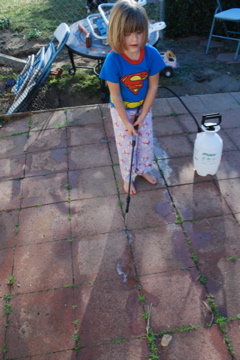
Now I had to take care of it. First stop, Google. I read up on natural herbicides. What could I use that would be nearly as effective as a glyphosphate-based weed killer? The bulk of articles favored straight white vinegar applied with a pump sprayer. So I went to Home  Depot and bought a sprayer for about $10. Then off to the local grocery store for several gallons of white vinegar. Finally, I soaked all the weeds in the back and stood back to see the results.

They were amazing.

Below are a series of photos showing the application process and the results over a five day period. Bottom line: this is totally the best way to go. Added bonus: Kaia gets to help.

Read Full Post »

When I was 12 (hey it was not THAT long ago!), I had an accident that pretty much confined me to my couch for a few months. I was a VERY active tomboy, so after about a week of watching television and reading I was going crazy.

Say it with me: CRAZY.

A friend of my mother’s offered to teach me how to crochet. As desperate as I was, I lunged at the opportunity. So a group of us pre-teen girls would get together and have classes. We crocheted, we talked, we laughed, which really helped distract me from the long recovery. Kathy, if you’re reading this, THANK YOU!

Time went by; friends started having babies; I started making blankets; but no matter how much I tried I just could not get past the “square ” crochet, so blankets was pretty much all anyone got.

After I had Logan I felt emboldened to try more complex knits. I mean, I was a MOM, and once I became a mom, long dormant genes had awakened. I figured one of them had to be the “knit” gene. So I took up a knitting book—the basic “teach yourself to knit” type. Success! I learned to make a hat!

By the time Kaia came along, I had advanced to booties, so she had the full outfit—hat, booties, blanket!—when she was born. And I had found a creative outlet that was portable, fun, and easy to start and stop—except for the starting and stopping part. You see, as the kids and their dexterity grew, projects were abandoned with increasing frequency as I found the needles in increasingly interesting places—and consequently not in my project. When Kaia was hitting her first birthday, I was hitting my limit. I put the needles down (more or less) permanently.

Then in November, the month after Kaia turned four, I came across knitting looms. At first I was unsure if the looms could give me the same satisfaction as my needles. Turns out not only am I satisfied, I am thrilled.

Say it with me: THRILLED.

I can leave my knitting for days, know exactly where I was when I left off, and the kids have not messed up one project. In the 8 weeks or so I have worked on the looms I have made over 30 hats, which was perfect for a Christmas where we chose to emphasize giving handmade gifts over purchased ones. I’ve also made a few cool scarves, and I’m in the process of doing a blanket with a stuffed teddy bear head for a baby shower. I have lots of other ideas turning in my head, too. I’m a knitting genius.

I have even inspired my brother-in-law and his kids to take up knitting.  Apparently he is using it in the place of a bad habit he is trying to kick……I expect a hat (or 20) soon!

I personally have the knifty knitters round and long looms; they come with basic instructions and you can watch demonstrations and get patterns or craft ideas online. Any fellow knitters reading this? Wanna share secrets and ideas?

Knit on!

Read Full Post »

« Newer Posts - Older Posts »

Design a site like this with WordPress.com
Get started