Feeds:
Posts
Comments

So far, so good. That’s the word this week. Except for the vole. Yep, my sister actually saw it and tried to catch it. She grabbed it’s tail as it darted down it’s hole and it screamed.

She let go. Instantly. I would have, too.

I’m not so sure that the vole dislikes the blood meal. We’ll see.

I’ve used the blood meal wherever I saw mounds or tunnels, punching holes at regular intervals and dumping a handful of the meal in. Then I cast the meal over the surface of the affected area, soaking it into the ground with a hose. The added benefits are a) it’s a great fertilizer and b) the rabbits hate being around it, too.

We’ll see what next week brings.

How are you doing with the furry little buggers? Any successes?

It’s bike month!

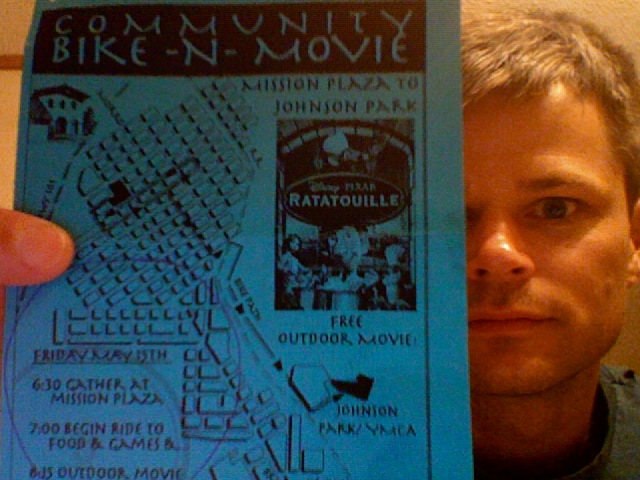
Denette handed me this flyer today.

Photo 377.jpg

SLO Rideshare has done an awesome job of putting this together. I don’t know about you, but riding to an outdoor screening of Ratatouille with the kids sounds, well, perfect.

And the timing of bike month is kind of perfect, too. I’ve been thinking about riding again for a number of reasons, fitness and kid time among them. I even unburied the bikes from the storage shed. And uncobwebbed them. And undusted them. Now I just have to reinflate the tires.

Then there’s the serious repair. So I’m going to take them to the bike kitchen at Mission Meadow Park where someone knowledgeable can perform magic and make them rideable.

And I’m definitely doing the Errands by bike day on the 23rd.

How about you? Are you a biker?

This is the first paragraph of wikipedia’s definition of planned obsolescence:

Planned obsolescence or built-in obsolescence[1] is the process of a product becoming obsolete and/or non-functional after a certain period or amount of use in a way that is planned or designed by the manufacturer.[1] Planned obsolescence has potential benefits for a producer because the product fails and the consumer is under pressure to purchase again, whether from the same manufacturer (a replacement part or a newer model), or from a competitor which might also rely on planned obsolescence. [1] The purpose of planned obsolescence is to hide the real cost per use from the consumer, and charge a higher price than they would otherwise be willing to pay (or would be unwilling to spend all at once).

I had a 1940-something Maytag wringer washing machine that I bought  in the 80’s at a garage sale for $5.

I used it for the next 12 years. The only part I had to replace was the motor belt that would wear out. Our local appliance dealer had them in  stock. Planned obsolescence was NOT the marketing strategy  for this company in the ’40s.

I dare say the opposite strategy was the intent. The idea back in the beginning  was to get people to buy their product. Innovation was key; that and offering a product that filled a need. One of the main selling points was longevity for both the product and the company that was selling it.  Start-up companies had to  build a reputation and a name for themselves. Quality, durability, and reliability were the hallmarks. Maytag has been around since 1911. To write this post I checked out the History of Maytag, which was very interesting. F.L. Maytag had a great philosophy and created quite a few firsts for his company.

Quality and trust were paramount. Fredrick Louis Maytag 1909 said, “There is a factor that can not be measured in dollars and cents…the spirit and love that a true craftsman holds for his job.” If this is any indication of what it takes to be a success—and Maytag was very successful—I am hard-pressed to find anything comparable in today’s marketplace.

I am reminded on a daily basis how planned obsolescence plays a major role in my life, a constant reminder of things that just give out or give up, just quit or malfunction because of some minute computer chip, glitch, or flaw. I can not reasonably expect that my laptop, or even my stovetop,  is going to behave in a reliable manner given all the variables that sustain it.

When I was using the old Maytag washer I always had several spare belts on hand.  If one morning I needed to change the belt it was not an event that involved calling or making an appointment with a “genius”, getting into my car and driving somewhere, find and pay for a parking space, wait until my name is called only to learn that they will have to keep it for a week to “reprogram it.”

If I needed to change the belt I went into the junk drawer where the belt and pliers were. I loosened one nut, slid the old belt off, put the new belt on, tightened the nut, put the pliers away and I was good to go.  The part cost me $2.59 which I had on hand and 15 minutes of my time.  It was as good as new.

Why can’t today’s products and  technology make things that last?    Why does it have to be sooo expensive and so hard to maintain and keep up?  I had to throw my first laptop away because the screen started to get lines in it.  The hard drive was fine.   It would cost over  $800 to replace the screen.   I replaced the whole computer.  I could change the spark plugs, oil and pretty much maintain my vehicles which made life a lot easier and less expensive for me.   Now I can’t even find the spark plugs on the newer vehicles and it takes special computerized equipment I don’t own to talk to the on-board computer to find out where the spark plugs are.     I have a 1982 Toyota pickup. It runs great. Everything works great but it will not pass smog.  Why?  The one and only  computer chip that sends air to the carburetor is broken.  The chip cost $230 and the labor is $200.   I can’t do a thing about this.  It cost me $90 to have a mechanic tell me what the problem was.  The State says throw the truck away.  It is not worth fixing.  Again, what a waste.  But that is what planned obsolescence is all about isn’t it?   I grew up with an old saying you do not hear much anymore, Waste not, want not.  It made sense back then and I think it still does.

A disposal, throw-away, get-a-new-one mentality,  is what is making the world go round.  I think I liked it better when things were built to last, workers were proud of their work, and companies planned on being around as a trusted reliable source of goods and services for a long time.

To add insult to injury I tried to extend the warranty on my new computer. The company said no, you missed the one month window to renew.  We don’t want your insurance money.  This does not give me a lot of confidence. They know something I don’t.   They know I will be back in 3 years to replace this one.   I will have to pay 4 times as much for a new computer instead of them repairing the old one on my extended warranty.  In the mean time every upgrade, download, which I don’t want or need,  causes a chain reaction which causes more bugs, and more upgrades and things just get worse instead of better.  Not like replacing a worn out belt and making it as good as new.

Like I said at the beginning. And then, of course, there’s…

Style obsolescence

Marketing may be driven primarily by aesthetic design. Product categories in which this is the case display a fashion cycle. By continually introducing new designs and retargeting or discontinuing others, a manufacturer can “ride the fashion cycle”. Examples of such product categories include automobiles (style obsolescence), with a strict yearly schedule of new models, and the almost entirely style-driven clothing industry (riding the fashion cycle) and the mobile phone industries with constant minor feature ‘enhancements’ and restyling.

Don’t get me started on the switch from analog to digital.   This stuff drives me crazy.
The wigglettes!

Hey gang! Here’s a bit more information about the worm bins we created in the last episode. So now you have NO excuse not to start one. 🙂

  • First, make sure you get red wigglers for your bin. They like working in close quarters. Earthworms are just the opposite. They hate being confined and are much better out in the wide open spaces.
  • Next, our dear little babies don’t like light; that is why we painted the drawers black. To keep it dark. Even though they have no eyes they are light sensitive. Too much light exposure paralyzes them and they dry up and die in less than an hour. Then you cry. Then you have a little wake, with music and a nice glass of wine…. Anyway, keep the bin in a shady cool spot with good air circulation.
  • Now, make sure they have enough “bedding”, i.e. wet newspapers. No glossy or fancy paper. Keep it simple. They will eventually digest all the bedding into compost also.
  • Tip: The ratio is 2:1. Two pounds of food for every pound of worms. There are about 1000 worms in a pound. One pound of worms can eat 2 pounds of food in a day. Yes, that’s a LOT of kitchen scraps!
  • Finally, don’t give them any moldy or spoiled food or the bin will start to smell and attract flies. Keep it fresh. And remember no meat, dairy or citrus. They are picky eaters in that respect and will just high tail it out of there.

If you want to make worm tea or wrangle give a holler. We got people and places for you to go to learn more. Tell us how you are doing, too. We’d love to hear how well (or not) it’s going!

I wrangled for the first time about a month ago. Because it’s more precious than gold, I used the worm tea for my favorite plants and I started some tomatoes with the compost. It is, without a doubt, the BEST, MOST COMPLETE compost you can find. And you can grow  your own!

The gopher wars

It has begun.

Logan and Kaia planted sunflowers about two weeks ago for the Great Sunflower Project. Two little shoots popped out of the ground last week.

They’re gone now, a telltale mound running directly beneath where they used to be.

This, of course, means war. So I went to Farm Supply to pick up something that will either a) repel the gophers or b) kill them. I’m going with option a) first, but if that doesn’t work I will move to option b) with extreme prejudice. The first attempt is blood meal.

Updates to follow. Keep your fingers crossed that the gophers get the hint and I don’t have to resort to more drastic measures.

Think Caddyshack.

Episode 4!

All right, gang, we’re back with another jam-packed episode!

One of our goals has been to make this into a collaborative effort, and it continues move in that direction. Jeff Jensen, my friend from High School (that place I went to nearly 20 years ago!) sent me some music to include in this episode, and I’m thrilled to add him to our growing collection of great artists. (Now if only I could get Fear Factory. What, not the right tone? Okay, fine.)

It’s also really cool to see the progress we’ve made on both the filming and editing front. We’re actually improving. Although we can only improve so much with me in front of the camera….

This episode sees us doing a little catch-up to get on schedule with the seasons: we pack the summer garden tearout in with the what I call a “winter garden medley”—photos of the garden as it grows over three months. Now our filming schedule will only be a month off instead of six….

We also take a trip to Mt. Olive where I learn a LOT about organic farming, and, inspired by their worm bins (200 tons of compost?! Seriously?!), I set out to build my own.

Join us! And let us know what you think!

And what a beautiful weekend it was for shooting scenes and planting veggies!

First, we prepped:

  • We soaked the beds thoroughly
  • I tilled to loosen the dense loam
  • We sprayed worm “tea” (read: poop) on the soil and then tilled it under

Then we planted:

Lots o' bounty!

As you can see, the right-hand bed still has some hangers-on from the winter planting. We’re going to make the plants in this bed multi-seasonal.

The mound in the middle is comprised of a) my failed composting efforts and b) my successful (though unintentional) greenhouse efforts: the little cantaloupes had started in the “compost” so I just transplanted them to the mound. I’m a genius (also unintentional).

potatoes-day-1

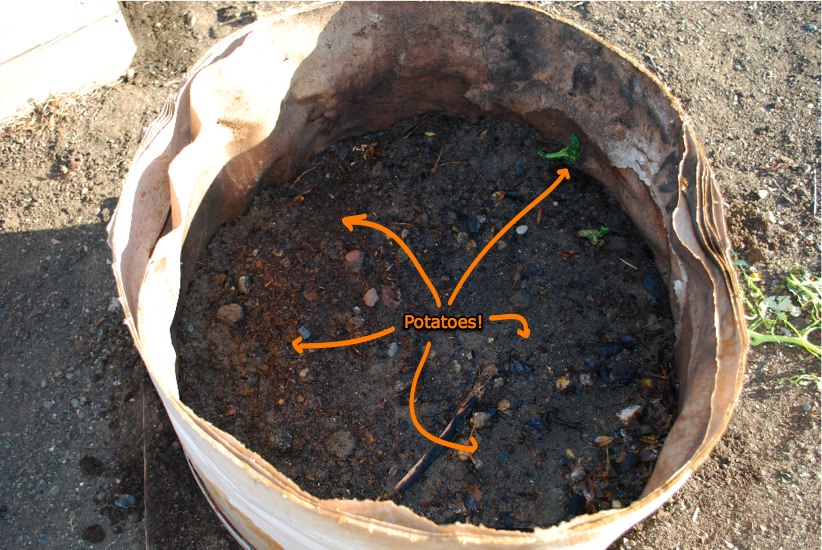
Finally, we planted some potatoes, some already started—again, from my composter-turned-greenhouse.

Now we water, we weed, and we wait for the sweet, sweet rewards!

How about you? Have you planted your summer garden?

Habitat For Humanity Wins The Green Business Award!
San Luis Obispo County Green Award 2008

This is a great place to shop. I got a 12 foot metal pole for our clothesline for $4.30! Bathroom fixtures, lighting fixtures, paint, tools, hardware, nuts, bolts, screws, tile…oh my!

Even kitchen sinks.

Very helpful, friendly volunteers, and even customers, seem glad to help a damsel in distress, which would be me. I am trying to put together an outside antenna contraption and don’t know what the heck I am doing. So, if you are in the market for a project and need some materials I would give the ReStore a look see. I like to know where my money is going and this sure makes me feel good when I spend it here: all the proceeds go to building green Habitat for Humanity houses.  They provide a great service to our community and, well, look they won the Green Business Award for goodness sakes. The press release is below (with links from lil’ ol’ me).

Habitat for Humanity is one of six businesses to win the Green Business Award from the Sustainability & Resources Committee of the San Luis Obispo Chamber of Commerce, for the environmental benefits of our ReStores located in San Luis Obispo and in Templeton.

Criteria for selecting award finalists include long-term environmental benefits, project transferability, environmental leadership, creativity and other considerations. Members of the Green Awards Committee include individuals from the City of San Luis Obispo, SLO Air Pollution Control District, Ride-On, SLO Regional Rideshare, SLO County Agricultural Commission, The Environmental Center of San Luis Obispo County, Integrated Waste Management Authority and SLO Chamber of Commerce.

‘We are truly honored to win this years Green Award,’ states Penny Rappa, Executive Director of Habitat. ReStores help the environment by reducing the amount of usable building materials dumped into our local landfill. ‘Since the opening of the Templeton ReStore in January of 2005, and San Luis Obispo ReStore in October 2007, we estimate over two tons of materials have been diverted from the local landfills annually,’ states Rappa.

Habitat for Humanity ReStores are building material thrift stores, receiving and selling new and used building items. ReStores provide an opportunity for the public to donate building materials and to buy quality building materials at very low costs. Doors, windows, cabinets, sinks, light fixtures and other building supplies are given a second life. All proceeds from the ReStores are then used to build new Habitat homes in San Luis Obispo County.

Habitat of San Luis Obispo is in the process of completing four homes within the City of Atascadero, with a home dedication planned for December 13, 2008. Plans are also in motion to build four similar homes within the City of Grover Beach in 2009.

Habitat for Humanity of San Luis Obispo County has built simple, decent housing in Paso Robles, Cambria and in Atascadero. HFHSLOCO was established in 1997, as a non-profit organization and an affiliate of Habitat for Humanity International. All donations to the ReStore are tax-deductible.

The ReStores are open Thursday through Saturday from 9:00am to 3:00pm.
For more information on what building materials the ReStores accept and sells please call: Templeton 434-0486 OR in San Luis Obispo 546-8699.

Tom Ogren is a genius. Last week we did a frenetic cross-town exposition on plants, allergies, and health with him. As he showed us around SLO, pointing out the allergy-inducing plants that abound in public places, it sunk in to me that we’ve been pretty careless about how we’ve landscaped our homes and our city. (I’ve created an interactive map of our journey so you can follow along and see which plants Tom identified).

Tom explaing the finer points of oak pollination to me.

Enter Tom Ogren. His findings mark the next step in creating a sustainable, livable environment. In a nutshell what Tom has discovered over 25 years of investigation and analysis is that allergies are getting worse—and we are responsible.

Why? Because we apparently don’t like cleaning up a mess.

Now, during our walk, Tom threw out a few latinate terms that I certainly can’t remember (you’ll have to read his book to get the full story), but the gist is that many female plants produce seeds or berries.

Which fall off.

Which we then have to pick, sweep, or scoop up.

So, to avoid the trouble, we just plant male trees instead. And this is where we shoot ourselves in the foot—or up the nose. Because male trees usually produce pollen.

Tons of it.

And since it doesn’t have anywhere else to go, it goes right up the schnoz.

Bottlebrush: it might look gorgeous, but you'll want to enjoy from a distance

Not that any of this was intentional: for many years landscapers and homeowners simply chose plants based on their aesthetic appeal. The most obvious example of this type of philosophy can be seen in the water-intensive lawns and plants that still dominant our cityscape. Now, however, given the burgeoning awareness of our limited resources, there has been a concerted move toward sustainable landscapes. Beautiful new front yards are beginning to appear based on this new, sustainable approach.

We need the same awareness to burgeon (I love that word) about creating allergy-free landscapes. It is a means of creating a sustainable environment for our eyes, lungs, and immune system. Seriously. Given the amount of money we invest in anti-allergy medications, this is a very expensive problem that could significantly reduced simply by changing our landscaping practices.

And some cities are already doing it. With Tom’s advice and guidance, several cities in the southwest and, believe it or not, in New Zealand, have adopted landscaping policies that forbid certain plants and that require the planting of female versions of others. They’re very progressive. Even feminist.

Lastly, Tom recommended a few things you can do to at least limit the effect of seasonal allergies. A list:

  • DON’T rub your eyes. Some pollens look like miniature ninja stars or balls of spikes, so rubbing your eyes when they itch will only result in itchier eyes that are now bloodshot
  • If you’ve been outside for a while (especially if it’s been windy), take a shower and put on fresh clothes once you’re inside
  • If your allergies are really bothering you, stay in the shower, close all the windows and the door, and make it hot—the steam will help clear your sinuses
  • If it’s a bad allergy day and you can make it to the beach, do it—the fresh air from the ocean will clear you up
  • Lastly, and most importantly, buy and eat local honey

I had no idea the last bastion of male dominance would be in the plant world. Go figure. Now that I do know, feminists unite! Let’s get female plants their rightful place in our yards and streets!

How about you? Do you have allergies? Have they gotten worse? How do you deal with them?

Well, now we’ve gone and done it: organized our first event. We’re inviting people and everything.

This event is going to be different, though. Are you surprised? You really shouldn’t be. We are different. Or so my friends tell me. All the time.

So here’s the event. And you’re all invited. And if you can’t make it, don’t worry, you’ll see our edited version soon enough!

What: a frenetic cross-town exposition on plants, allergies, and health with Tom Ogren, author of Safe Sex in the Garden.
When: Wednesday, April 8th, from 1PM to 3ish
Where: Three separate locations around downtown SLO
What to bring: A notebook, questions, and a form of transportation

Details: We will meet at Meadow Park by the basketball courts. I will be your MC, and we will be filming the whole thing. Tom will take us on a tour, explaining the causes behind our allergies, showing us the worst plant offenders, and explaining how we can be proactive in reducing allergen propagation.

Come and join us! It will be a blast!

Design a site like this with WordPress.com
Get started