Feeds:
Posts
Comments

CalpopsGarzasWash08www.montereybaycnps.org/

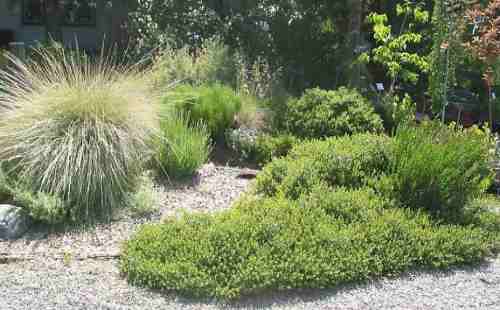
Let’s do it.    Get rid of the grass, at least most of it and plant fire resistant, drought tolerant, disease and bug resistant, sexy, wild,  natives.  Native fire resistant plants are a real asset to your yard anywhere in California. Did you know that a watered apple tree or Indian Hawthorne burns better than an unwatered Ceanothus, and with just a little water Salvias (Sages) are harder to light than a watered fruit tree?  Easy fixes for high risk fire areas.  Here is a picture of a garden landscaped with fire retardant plants.garden-tour-2

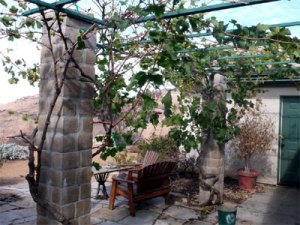
Plant natives grapes which are fire resistant make a beautiful arbor or barrier and you can eat the grapes.  fire_562s
Plant natives to attract bird, butterfly and hummingbirds.  Milkweed is the only plant the monarch uses and it also attracts swallowtails.  butterflyweedThe natives  are very low maintenance. They can be very showy and spectacular like our California Lilac,  Ceanothus, left, Ceanothus_L.T.Blueor low and inconspicuous like Pacific Mist Arctostaphylos, right.images Pacific Mist loves coastal sandy gardens where it grows one foot high and 6-8 feet across. Then there are the fragrant varieties for your smelly garden. California Mock Orange (Philadelphus lewisii) center.

a494-1

And so many sages.  This one is called Hot lips and hummingbirds love it. large_salvia

Natives have everything you need for a carefree spectacular garden.   Save money on water, pesticides, herbicides, fertilizers, save time, mowing, weeding, hedging, spraying, and the energy savings in hard labor are all good reasons to Go Native.

By planting natives and getting them established, which does take a little time in the beginning, you can just let them do what comes naturally and leave all the work to them.  There are perennials which come back every year, annuals that reseed themselves, hardwoods, softwoods, bushes and trees for the layered effect.   There are many varied reports on  deer resistant natives.  You will have to check with your local extension or neighbors on what works best in your area.  I think the general consensus is they love roses and if they are hunger they will eat anything.  So, this one is up to you.

Check out the gardens below.
nativeplantswww.thedigeratilife.com/…/

p_ng_mass_bl2www.cnps-yerbabuena.org/…/local_gardens.html

gardenwphttp://tinyurl.com/ctx8l4

This is a very good site.  Full of fun facts and information.  It is hosted by Randy White.  The site below, Food not lawns, is just a little off subject. I just thought I would put it in here to give you something to think about.  It is well worth a look see.  You can’t help but learn something.

flores_food_not_lawns_1

http://www.foodnotlawns.net/

I have taken you on quite a tour and it is just the tip of the iceberg.   If you just want to get started a good place to start learning about  natives is at  the California Native plant society the local chapter here is  http://www.cnps-slo.org/  They have field trips to local areas and a great list of nurseries that carry native plants.   One nursery on the list is Las Pilitas http://www.laspilitas.com/  It has an online Landscape and  design plan.  You just answer some questions about your planting area and it will tell you what plants to plant and where. Also, a must read on fire prevention.

And now that you are thinking about Going Native you can also start thinking about what you are going to do with all the extra time and money you will have after planting a native garden.  The time you save you could spend oh, I don’t know, sleeping, surfing.  Kowabunga  Dude.  Have Fun.

it occurred to me today what is so cool about grassroot movements. the cool thing is you are dealing with the principals. people in charge of everything.  they can change a light bulb or the direction of a company in the same breathe. things get done quicker and you feel more a part of what is happening. your input is important and makes a difference.  you can see things happening as you speak so to speak. it is actions-speak-louder-than-words in the flesh.  unlike a big company that is 46 menu options  and continents away from a real voice and all you end up saying is ‘what did you say’?  yea grassroots is the place to be if you want to make a difference and get something done. very empowering.  Fun for a change.

Garden update!

I’m not very good at the whole “right on schedule” thing, I must admit. That said, here are a few shots of the “winter” garden just as we start to transition into a “summer” garden.

Here in SLO we should probably label the seasons “wet” and “dry,” but I’m splitting hairs.

I’m afraid we pulled some of the leeks a tad early. (Sorry, Heidi! It looks like we’ll have to use non-homegrown leeks for the lasagna). The white parts need to be, like, three times longer.

On a positive note, the broccoli is finally taking off. I can’t wait to dig in! (In fact, I kinda already sneaked some. Shhh…)

In a week or two I’m going to post a detailed review of our winter garden. In the meantime, here’s a quick winter garden wrap up, with the winners, the competitors, and the also-ran.

The winners:

  • bok choy (one word: prolific)
  • leaf lettuce (just keeps growing and growing and…)
  • spinach (just keeps growing and growing and…)
  • green onions (SO sweet and tangy)
  • radishes (our fastest growers of the season!)

The competitors

  • broccoli (slow starter, but we’re seeing action now!)
  • head lettuce (died back very quickly after reaching “peak”)
  • leeks (need lots of time to grow)

The also-ran

  • red and yellow bulb onions (la de da, any DAY now)
  • carrots (had better luck with the summer batch)

I must say, it was a great first experience with a winter (wet season) garden. I’m already planning for next year.

How about you? Did you do a winter garden? How did it go?

I made a lot of money last year; I spent quite a bit of money, too. Around December I made a calculation of my finances to date:

  • A lot – quite a bit = not very much left over.

With this number in my head, I made a firm commitment to take stock of my finances and gain control of my expenditures. So the first thing I did was open a Mint account.

And I realized something almost immediately: I was spending a lot on self aggrandizement. Mint kindly pointed out to me that…

  • I like my expensive meals out (because Taco Bell just doesn’t cut it any more)
  • I like my Apple and related geeky electronic stuff
  • I like my outdoor gear
  • I really like food in general

Really, I should say we, because Denette and I both drink from the same fountain. But I’ll save that POV for her post. Anyway, I’ve been liking these things too much. Especially the expensive meals and the geeky electronic stuff.

As I started getting control of the expenditures a really interesting thing happened: most of the money I’ve started saving is, of course, going into the savings, but a larger percentage than I’ve ever spent before is going to causes Denette and I support, like One, the Sierra Club, Greenpeace, and St. Jude’s. I had been using it to buy things I wanted, but now that my spending  habits were explicitly displayed for me, I knew that I could be giving a much larger portion of it to someone who actually needed it

Even more significantly, I’ve started volunteering again with groups and organizations who strive to make a difference, such as ECOSLO. Which is, quite simply, the most satisfying way of doing good. I feel again as if I am the change, instead of just a supporter of change. Doing pwns donating.

Oh, and it totally puts the self-aggrandizement in its place.

Which feels really, really good.

Which feels like my childhood, when I devoted a significant amount of my time to the community and learned much of what I know now but seemed to have forgotten a little over the years. Back then it was not about money; it was only about helping.

Red wrigglers

Thank you, Freecycle! We just picked up two real (as in designed for the purpose) worm bins. And we even got the red wrigglers. Now, along with our homemade bin, we will have plenty of compost and castings. Plenty.

Worms and all!

The woman who freecycled the bins told us that she had gotten them for free from the City of SLO. Time to put on the Deerstalker and investigate!

Hercules and Catwoman are thrilled!

First, can someone please tell me why I decided not to get a dryer in the middle of the rainy season? Still, I have managed to hold my laundromat trips to a minimum; two precisely. And that was to dry the thicker towels and blankets. I do believe that in the nearly 2 months I have not had a dryer, that is pretty good, don’t you think?

The clothesline Samson and Jeanne made works wonderfully.

Mostly.

We are still working out a few kinks, but in the end I will have the coolest line on the block! Then everyone will be jealous. Kind of like an episode of “Desperate Housewives,” without all the makeup, drama, or women.

The secret? It is really all about time management.

I put the clothes on the line during the sunniest part of the day; for us that is mid-morning to mid-afternoon, after the fog has burned off and before it rolls back in. I leave around 8am to take Logan to school, so I throw a load in the wash before I go and then by the time I get home the clothes can go on the line to dry.

I also have found that one load a day is the best answer. I have never been a “separator.” All my clothes are washed together in warm/cold with a gentle, environmentally friendly detergent and rinsed with a little bit of white vinegar (LOVE that stuff!), so having one load a day is really no problem. Oh, and as for whites, the sun is amazing for making the whites white.

The only problem is if I am not home to do the one load a day, it backs up on me and I am back to stringing up another clothesline on the back porch. That’s when I miss the dryer. I suppose I could just have Samson stand in the laundry room and breathe hot air over them…LOL!

Now I am off to hang some clothes….no really!

Banner ART

Have you SEEN our banner? Is it not awesome? Here’s the full image:

A beautiful rendition!

It’s hand painted oil on wood, and you should see the actual work. Totally captivating. The artist has never done anything like ‘orange crate art’ before and decided to have a go at it. I am so glad she did. All the plants and animals in the picture are natives and that is actually Bishop’s Peak in the background.

This work of art was created by Melina, a local talent. Originally born in Buenos Aries, Argentina, Melina moved here to study Fine Arts, Fashion Design, and English. In addition to painting, she writes, designs, and makes jewelry. And incredible orange crate art.

You have to check out her website! It showcases the great diversity of her work, such as her surrealist and abstract pieces, which are among my favorite.

My mom and I feel quite privileged to have someone of Melina’s caliber submitting art for our banner. If you like what you see you might drop her a line and let her know. Or leave a comment here and we’ll make sure she sees it.

Episode 3!

First, for those of you with RSS readers, I fixed the blog title so it shows up on the feeds again. (Thanks for the heads-up, Chris!)

And now, the next episode! It’s a  jam-packed one. My mom and I are really starting to get the hang of this—except maybe for the whole indoor lighting thing. You’ll see what I mean.

Wait until you see the garden! It’s insane how big the veggies (and the sunflowers) got. I mean it. Insane. We also get to the SLO Farmers Market, where I interview some of our local farmers (and a bee keeper). Logan and Kaia track down some lizards to show us, and my mom and I have a coffee and talk about the triple bottom line philosophy. Like I said, jam packed!

I’m totally stoked at the momentum we’re building for Hole in the Fence. There are great things happening here and I can feel the energy! I hope you do, too.

Let us know what you think in the comments. We love your feedback!

Weekend weeding

I love the rain! So does the garden!

So do the weeds. It was time to do some serious weeding.

I pulled the big weeds right out of the rain-soft ground. I’ve found there’s actually an art to pulling weeds with the entire rootstalk intact. And I really get into the challenge of seeing how many weeds I can pull out whole.

The kids jumped right in. Logan gathered the weeds I’d pulled and Kaia played in the mud.

On the smaller weeds we used straight white vinegar, which is, as I’ve said before, the edible version of Round Up.

And by edible I mean, if you get a bit peckish while your weeding just grab some lettuce, apply a little of your weed killer, and voilà! instant salad.

It’s weird: a project can look massive and onerous, but once I get rolling it’s done in half the time AND I end up enjoying it. Or maybe that’s just me—made half crazy from all the vinegar.

P.S. I also wanted to demonstrate my awesome weed-pulling skillz with an animated gif, but the site that would have allowed me to do that suffered a server crash, so…another time!

An affirmation

Okay, so the environmental group I’m working with? The one I just blogged about? You might have guessed by now that it’s ECOSLO. Well, they’re taking part in Art After Dark, and last night they had Adam Hill, the new District 3 County Supervisor, as their guest. And I’m affirming that they are definitely doing good things. I met some very cool people there (in addition to Adam, of course).

However, the event was attended by about 45 people, max. I know, because I was there the whole night, lurking. (That’s me: I lurk). And the type of people who attended were the type you’d expect: the wonderful, the well-meaning, the converted.

Total mildly curious and/or drunk attendees? Zero.

Now, maybe I’m being totally unrealistic, but I would have liked to see three times that amount. I mean, it was a chance to meet with a supervisor (and for some of us, a former instructor)! Not only that, but he’s cool. Actually cool. A politician. I know.

I’m drifting. Back to my point. Which was…. If an organization wants to stay viable it has to practice a certain amount of openness and inclusiveness. This has always been a truism, but now, with the current green zeitgeist racing through our collective consciousness, the time is perfect for opening heretofore closed doors.

Have to you ever thought that maybe, just maybe, thinking certain things actually brings them into existence? (Some physicists do, but they’re crazy.) Or maybe because you’re thinking of something you are more aware of similar phenomena? Anyway, I had just written the last post about inclusivity when I came across this article, tweeted by one of our followers. In the wonderful article (that is now in my “special” folder on my laptop), the author, Andrew Outhwaite, lists common barriers to achieving effective, long-term change. This one REALLY nails my thesis on the head:

Barrier: Being too identified with your own profession/network/clique, and its language, symbols, models, paradigms and habits can seriously inhibit inter-network collaboration, even within the sustainability movement.

Community-Enabling Technology: Encouraging information Cross-Pollination. Universities (e.g. BTH, UTS and RMIT) are encouraging transdisciplinary research to enable innovation across departmental, sectoral and epistemological boundaries.

Time to broaden the horizons, methinks. And to prove that I’m not letting any grass grow under my observations, I’m off to meet with Chris McCann, a student a Cal Poly who’s part of the Empower Poly Coalition and the business community. Let the synergies begin!

Design a site like this with WordPress.com
Get started